Last updated: September 10, 2026
Key Takeaways
- Inlet and outlet sizes are often 3 or 4 inches on the gravity side, while air lines are much smaller.
- If the replacement changes the system’s behavior noticeably, consult a licensed septic professional and recheck sizing and control settings within 24 hours.
- An aerator pump supplies air, not water, and that air keeps aerobic bacteria active in a treatment tank.
- Aerator pumps are usually rated by airflow, often in cubic feet per minute, and by pressure capability.
Aerator pump vs effluent pump confusion shows up constantly in septic work. And it causes trouble fast — bad drainage, dead treatment tanks, clogged fields, the whole mess. Looking at a septic system, a wastewater tank, or an aerobic treatment unit? Consult a licensed septic professional before buying or replacing anything. Short version: an aerator pump adds air to keep wastewater bacteria alive, while an effluent pump moves clarified liquid out of a tank and to the next stage.
Who this applies to, and what you need to know first
Homeowners, property managers, and anyone trying to sort out a pump in a septic or small wastewater setup are the people this applies to. I’m assuming you already know the tank belongs to an on-site system, not a basement sump, and that you can tell a liquid-filled tank from a pump chamber. No guesswork here. If you do not know whether your system is aerobic or conventional septic, that has to be settled before you buy or replace anything.
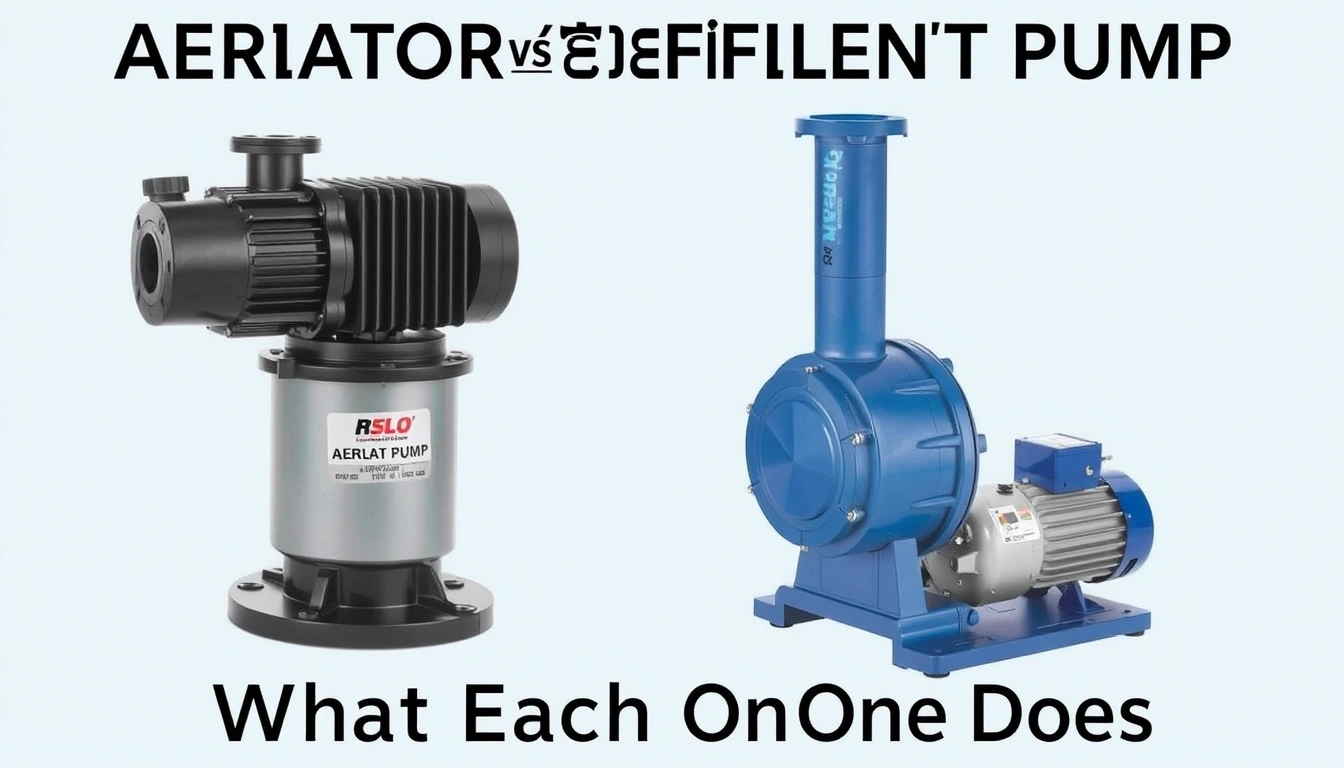
Practical, not academic. An aerator pump belongs in an aerobic treatment unit, where air is injected or circulated so oxygen-loving bacteria can break down waste; check the manufacturer manual or consult a licensed septic professional before swapping parts. An effluent pump, by contrast, is a transfer pump for clarified wastewater, usually after solids have settled or been filtered out. One treats; the other moves liquid. Different jobs.
If you are dealing with a cracked tank, sewage backing up into the house, electrical damage, or a system alarm that will not reset, stop treating this as a simple pump swap and consult a licensed septic contractor or electrician. Those situations can involve health hazards, damaged wiring, or a failed drain field. Get the right person involved. Now.
Trying to identify which pump you have, replace like with like, or figure out why one failed before the other? You can handle that with the right labels, tank layout, and manual. The terms to keep straight are aerobic treatment unit (ATU), a system that uses oxygen to speed biological breakdown, and effluent, the liquid that has already had most solids removed.
What does an aerator pump do?
An aerator pump supplies air, not water, and that air keeps aerobic bacteria active in a treatment tank. In an ATU, oxygen is the difference between a system that treats waste effectively and one that turns septic. The pump may feed an air diffuser, a membrane, or a mixing chamber. Its job is to keep dissolved oxygen available so the biological process keeps working.
Think of the aerator pump as the piece that turns a tank into a treatment unit instead of a holding tank. Without enough air, treatment drops off, odors get stronger, and the water leaving the tank can carry more organic load than the downstream parts were built to handle. That can shorten the life of the dispersal area. Ugly, really.
A few details matter. Aerator pumps are usually rated by airflow, often in cubic feet per minute, and by pressure capability. If a pump is undersized, the tank may bubble weakly or unevenly; if it is oversized for the diffuser, it can create noise, vibration, or excessive wear. Steady, fine bubbling is what you want — not a violent boil.
What it does not do is move settled wastewater to the next chamber the way a transfer pump does. If someone calls an aerator pump “the pump that empties the tank,” that is already a sign the system has been misunderstood.
What does an effluent pump do?
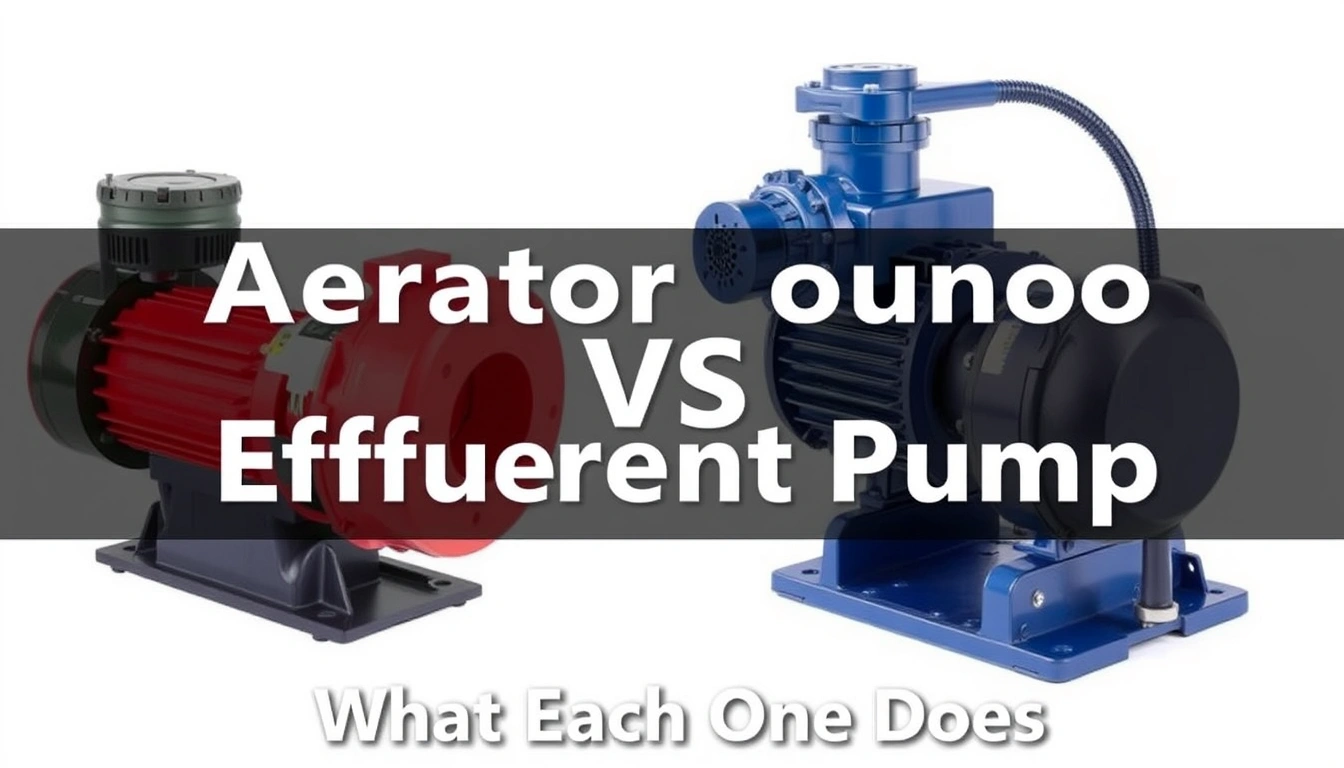
An effluent pump moves wastewater that has already been clarified, and it is built for that cleaner liquid, not raw sewage with large solids. In most systems, the tank lets heavier waste settle and lighter material float, then the effluent pump pushes the middle liquid to a drain field, mound, spray line, or a secondary treatment unit.
This pump is a mover. It does not create air, and it does not biologically treat waste. It usually sits in a separate pump chamber or in a compartment after settling. Many effluent pumps use a float switch or pressure control to turn on only when liquid rises to a set level. A common mistake is assuming any pump in a septic system can handle any waste. It cannot.
Field details matter here: effluent pumps often have limited solids handling, a screened inlet or pump vault, and discharge sizing that matches the piping run and head pressure. The term head means the resistance the pump must overcome to lift and push liquid through the line. If the head is too high for the pump curve, flow drops and the pump runs hot.
The big drawback is simple: an effluent pump is not built for thick sludge or trash. Force it to move solids-heavy liquid, and the impeller can clog, the float can stick, and the discharge line can plug. Wrong tool. If the chamber has not settled properly or the tank has not been pumped on schedule, the whole setup starts acting like mud through a straw.
Aerator pump vs effluent pump: how to tell the difference in the field
Function, plumbing, and the tank’s job tell them apart. An aerator pump usually connects to an air line and diffuser. An effluent pump usually connects to a discharge pipe and a float switch. One makes bubbles; the other sends liquid onward.
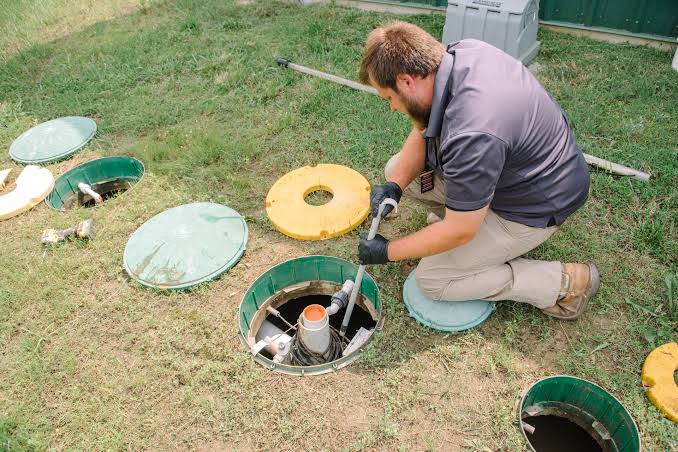
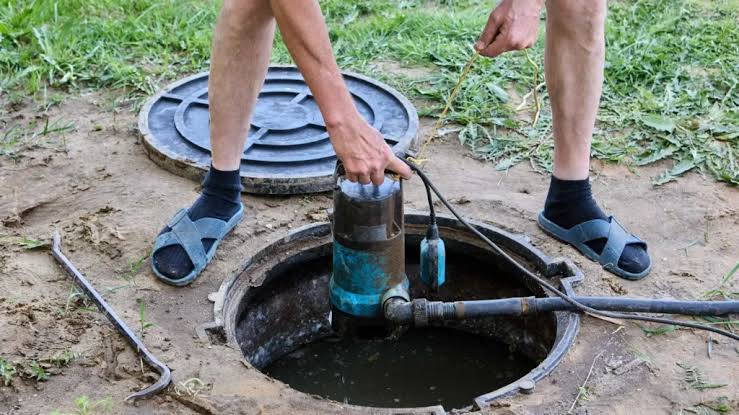
Start with the tank layout. In an ATU, you may see an air compressor or pump mounted above grade, with airline tubing leading into the tank. In a pump chamber, you are more likely to see a submersible pump at the bottom, a float tether, and a discharge line leaving the top or side. The labels on the lid, control box, or service panel often tell the story faster than the hardware itself.
Control names help too. Words like “air,” “blower,” or “diffuser” point to aeration. “Pump on,” “pump off,” “high water alarm,” or a float set point to effluent transfer. Find the manufacturer manual and electrical diagrams before any replacement. One mismatch can wreck a tank in a single season; EPA guidance on ATUs and pump chambers is a useful reference for what each component is meant to do.
One more clue: aerator systems often run more continuously or on a timed cycle, while effluent pumps run intermittently, only when liquid reaches a trigger level. If a pump turns on and off as the tank fills, that is transfer behavior. If it hums or pushes air steadily, that is aeration behavior. Simple enough.
How do these pumps fit into a septic system?
They sit in different stages of the process, and the sequence matters. A conventional septic system usually relies on settling and gravity, while an aerobic system adds air and may then move treated effluent onward with a pump. So the aerator pump supports treatment first, and the effluent pump supports distribution second.
Here is the sequence in plain terms:
- Identify the tank type. Look for the lid labels, control panel, alarm box, and manufacturer name. Verify whether the system is an ATU, a septic tank with a pump chamber, or a gravity-only setup. A problem sign is any box or tank whose purpose you cannot trace from the piping.
- Trace the inlet and outlet pipes. Find where wastewater enters and leaves. Inlet and outlet sizes are often 3 or 4 inches on the gravity side, while air lines are much smaller. If a “pump” has no discharge line, it may be an aerator, not a transfer pump.
- Check whether the unit moves air or liquid. Air movement means aeration; liquid movement means effluent transfer. Verify by watching for bubbles, hearing a compressor-like hum, or seeing a float switch. A dead-silent tank with no bubbles and no flow may have a failed aerator.
- Inspect the control equipment. A control box for an effluent pump usually includes float logic and sometimes an alarm. An aerator may have a timer, breaker, or compressor overload protection. If the breaker trips repeatedly, the fault may be electrical rather than mechanical.
- Confirm the outlet destination. Effluent usually goes to a drain field, sand filter, mound, or secondary tank. Aeration does not have an outlet in that sense; it serves the treatment chamber. If the outlet line leads directly to dispersal, that is effluent duty.
- Match the replacement to the old pump data. Check voltage, phase, horsepower, airflow rating, and head rating. For effluent pumps, the discharge size and pump curve matter. For aerators, airflow and pressure are the key numbers. A mismatch of even one parameter can make the system unstable.
- Test the control cycle. Raise the float or run the aeration cycle and watch the response. Verify that the pump starts at the correct level or the diffuser produces consistent bubbles. A delayed start, weak airflow, or rapid short-cycling means the system is not set correctly.
That order matters because the wrong diagnosis usually starts with the symptom, not the cause. Odor can come from failed aeration, but it can also come from a blocked vent or overloaded tank. Standing water near the field can point to a dead effluent pump, but it can also point to a clogged soil absorption area. The pump type is part of the diagnosis, not the whole answer.
When should you stop and get the system checked?
Stop when the problem is bigger than a pump swap, or when the pump type no longer matches the tank’s condition. This is where a wrong repair costs more than a callout.
Repeated sewage backup into the house: The problem is not just the pump; the system may be blocked, full, or misconfigured — Stop using water heavily and have the tank and downstream line checked before replacing anything.
High-water alarm that returns after reset: The chamber is not draining normally — Inspect floats, discharge piping, and the destination field, not just the pump motor.
Strong odor from an ATU: Aeration may have failed or dropped below the needed level — Check the air delivery system and control box before assuming the tank is “just dirty.”
Milky or solids-heavy liquid in the pump chamber: The settling stage is failing — Do not put in a standard effluent pump and hope it survives; fix the settling problem first.
Breaker trips, burned insulation smell, or water in the control box: Electrical fault is likely — Shut power off and have the wiring checked by someone qualified.
Unknown system type or missing manuals: You do not yet know whether the unit needs aeration, transfer, or both — Identify the tank model and wiring diagram before ordering parts.
For any of these, the result of guessing is straightforward: the new pump can fail quickly, and the real problem stays in the ground. That is how homeowners end up replacing the same part twice.
The mistakes people make with aerator and effluent pumps
Buying a pump by horsepower alone is the most common mistake. Horsepower sounds decisive, but by itself it tells you almost nothing. An effluent pump needs the right head curve and solids tolerance; an aerator needs the right airflow and pressure. Better to match the pump to the original spec plate and the system manual.
Another mistake is swapping an effluent pump into an aerator position because “it pumps.” That usually ends in poor treatment, odor, and stressed downstream components. Match the function, not just the voltage and wire count.
People also ignore the float configuration. A float switch set too close together can make an effluent pump short-cycle, which wears out the motor and starter. The fix is to use the float spacing the manufacturer specifies, often several inches between start and stop points, and to verify free movement in the chamber.
A fourth mistake is treating a fouled chamber as a bad pump. If the tank has sludge, grease, or debris around the inlet, the pump may be doing exactly what a pump can do and still fail the job. Clean, pump, or service the chamber first, then recheck the pump. That boring step saves money.
Finally, people forget about ventilation and air lines. In aeration systems, kinked tubing, a clogged diffuser, or a failed compressor can mimic pump failure. If the bubbles stop but the motor still runs, the issue may be in the air path, not the motor itself.
What changes in edge cases?
The standard guidance changes when the system is hybrid, old, or undersized. Some properties have an ATU feeding a pump chamber, then an effluent pump pushing treated water onward. In that setup, both pumps matter, and failure in either place can produce the same visible symptom: high liquid level.
Vacuum alarms and timed-dosing systems are another edge case. A timed effluent pump may run on a schedule rather than a float, with controlled doses measured in minutes instead of simple on/off cycling. If that is your setup, replacing the pump with a generic float-controlled unit can upset dosing and distribution.
Cold weather changes aerator behavior too. In exposed systems, airline condensation, frozen vents, or stiff tubing can reduce airflow. If the tank is in a climate where freezing is common, the same “weak aeration” symptom may come from the line, not the pump body.
Older systems can also use discontinued parts. When that happens, the safe path is to match specifications exactly or have a service shop cross-reference the original data plate. “Close enough” is risky here. Even a similar-looking replacement can have a different impeller, motor draw, or fitting size.
What a good result looks like
A good result is not just “the pump turns on.” For aeration, I want steady air delivery, no alarm, and a tank that does not smell anaerobic after a short time. For effluent transfer, I want the chamber level to rise and fall in a normal cycle, no rapid short-cycling, and no standing water where the line discharges.
If you are replacing one of these units, the finished job should leave you with the same or better operating pattern as the original: correct sound, correct cycle, correct discharge, and no alarm. If the replacement changes the system’s behavior noticeably, consult the manufacturer instructions or a licensed septic professional and recheck sizing and control settings within 24 hours